- July 7, 2025
AI-powered Grand Rapids Wood Recycling Company Has Raised $3.75 Million In Seed Money
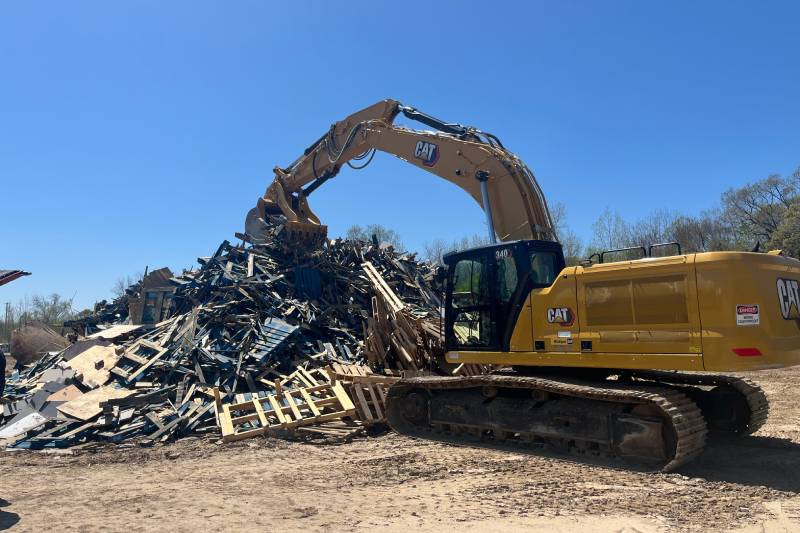
In order to improve operations and its artificial intelligence platform, a Grand Rapids-based firm that converts waste wood into biomass for the creation of renewable energy has raised $3.75 million in seed funding.
Todd Thomas, founder and CEO of Woodchuck, stated, “With this funding, we are accelerating our mission to help manufacturers and construction companies reduce waste, reduce costs, and contribute to the clean energy grid.”
In May, Woodchuck held a grand opening for what it describes as the first-of-its-kind processing that combines AI and all-electric wood processing to produce biomass sustainably. The facility, located at 2151 Butterworth Drive SW, can produce 83 million BTUs of renewable energy from 100 tons of wood wastes that are gathered from building sites and other locations.
Millions of tons of building waste, a large portion of which is wood, are dumped in landfills annually, according to Thomas. “With the help of our AI technology, we are able to recover value from this waste, converting it into clean energy and helping our clients reach their sustainability objectives.”
Four of the company’s 14 Michigan employees are based in Grand Rapids, according to Thomas. Last year, the business revealed plans to establish its headquarters in Grand Rapids.
Mason Fink is a southern California investor and fundraiser who spearheaded the effort to collect $3.75 million in early funding for Woodchuck. NorthStar Clean Energy, a CMS Energy firm, Alloy Partners, and Beckett Industries were other partners. Consumers Energy’s parent company is CMS Energy.
According to Thomas, Woodchuck wants to use recycling to assist its customers in achieving zero waste.
The business installs AI cameras in dumpsters on its clients’ construction sites. Woodchuck uses the AI cameras to detect, classify, and process the wood waste from those dumpsters, converting it into biomass. CMS Energy receives that biomass and transforms it into renewable energy.
According to Thomas, Woodchuck hopes to enhance the quality of its biomass by investing in its AI platform. For instance, poorly sorted wood that contains additional impurities, like nails and screws, yields biomass of lesser quality than wood that is contaminant-free.
Thomas, a resident of Scottsdale, Arizona, stated, “At first, all of our AI was on the front end to help us pre-sort materials.” “In order to further enhance the quality of the biomass, we are currently working on the back end as well, where we are utilizing AI during processing.”
The business also intends to enhance its AI tool so that customers may more easily obtain information about their recycling activities using Woodchuck.
“At the moment, our clients will receive the reports that we set up on a cadence every week or every month,” Thomas stated. “We want them to be able to schedule their reports on any cadence they choose by going into the portal.”